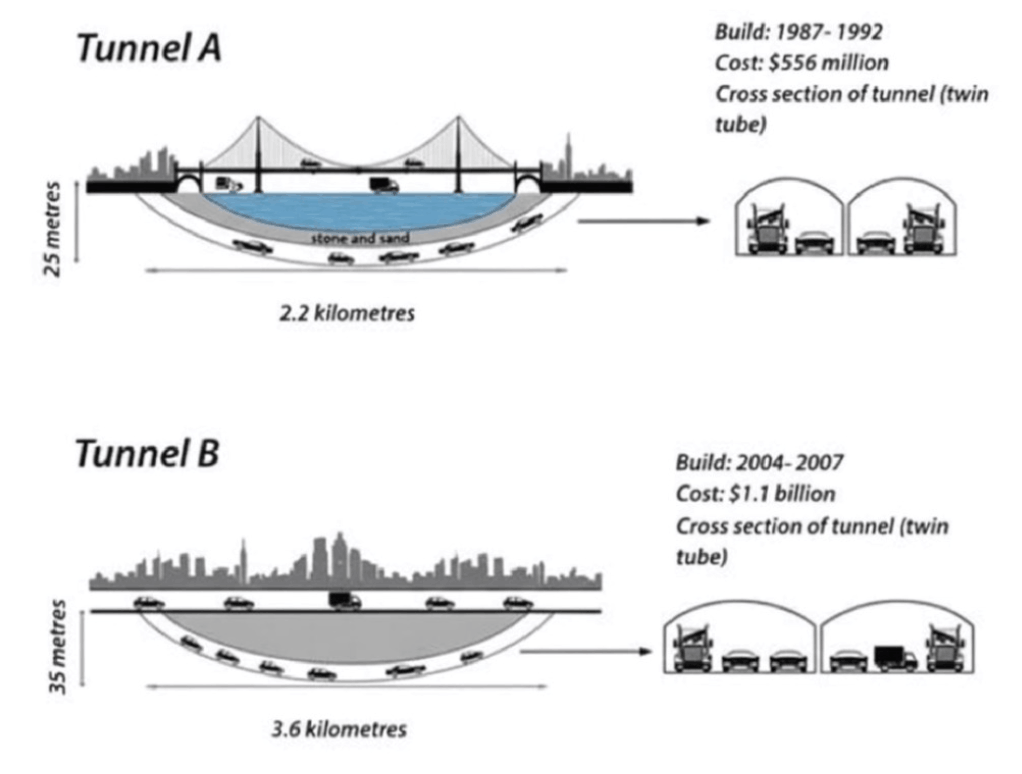
The diagrams below give information about two road tunnels in two Australian cities.
Practice this IELTS Writing Task 1 question on IELTSX. The diagrams below give information about two road tunnels in two Australian cities.
Two Road Tunnels Two Australian Cities Diagram - IELTS Writing Task 1
You should spend about 20 minutes on this task.
Summarise the information by selecting and reporting the main features, and make comparisons where relevant.
Write at least 150 words.
A student's answer to this task, and the feedback on it
Written by an IELTSX user under exam conditions and published unedited and anonymously. Band 7 · 193 words.
The diagrams provide information about two road tunnels in two Australian cities, including their construction dates, costs, dimensions and structural features.
Overall, Tunnel B is considerably longer, deeper and more expensive than Tunnel A, and it was constructed more recently. While Tunnel A passes beneath a body of water through sand and clay, Tunnel B through rock underground.
Tunnel A was constructed between 1987-1992 at a cost of $556 million. It is 2.2 kilometres long and reaches a maximum depth of 25 metres. The tunnel passes beneath a body of water, with structure surrounded mainly by stone and sand. It consists of two separate tubes, each carrying traffic in one direction, with two lanes in each tube.
By comparison, Tunnel B was built considerably later, between 2004 and 2007, and was more than twice as expensive, costing $1.1 billion. It is also longer and deeper, measuring 3.6 kilometres in length and 35 metres at its deepest point. Unlike Tunnel A, it runs through beneath the city rather than water. Its twin-tube design is similar to that of Tunnel A, but each tube contains three lanes, allowing more vehicles to travel through the tunnel.
Examiner feedback
The response is well-structured and covers all key information from the diagrams of the two road tunnels with accurate data and clear comparisons. The language is generally precise and grammatically sound, resulting in a solid performance across all criteria.
Task Achievement - 7
- All requirements of the task are appropriately covered, comparing both tunnels across construction dates, costs, dimensions, and features. - Key features are clearly selected and highlighted, supported by accurate figures from the prompt. - A clear and comprehensive overview is presented, identifying the main differences effectively.
Coherence & Cohesion - 7
- Information is logically arranged with a clear introduction, overview, and detailed body paragraphs. - Cohesive devices are used appropriately, though there is a minor mechanical slip in preposition usage in the second paragraph ('Tunnel B through rock underground'). - Paragraphing is clear, separating the overview and the detailed comparisons effectively.
Lexical Resource - 7
- The vocabulary is sufficient to allow precision and flexibility when describing dimensions, costs, and structural features. - Less common items like 'considerably longer', 'maximum depth', and 'twin-tube design' are used accurately. - Word choice and collocation are generally natural, with only very minor slips.
Grammatical Range & Accuracy - 7
- A variety of complex structures is used with good flexibility and accuracy, such as subordinate clauses and comparative constructions. - Grammar and punctuation are generally well controlled, with frequent error-free sentences. - Minor slips occur, such as the missing verb in 'Tunnel B through rock underground'.
Related prompts
- Male Female Students Art Related Subjects UK University 2011
- Town Centre Changes 1990 and Today
- Male Female Students High Grades Five Subjects Parston School National Average
- Qualifications Staff Advertising Company 1990 and 2010
- Australian School Leavers Activity 1980 1990 2000
- Layout Town Shopping Centre Present and Future Redevelopment