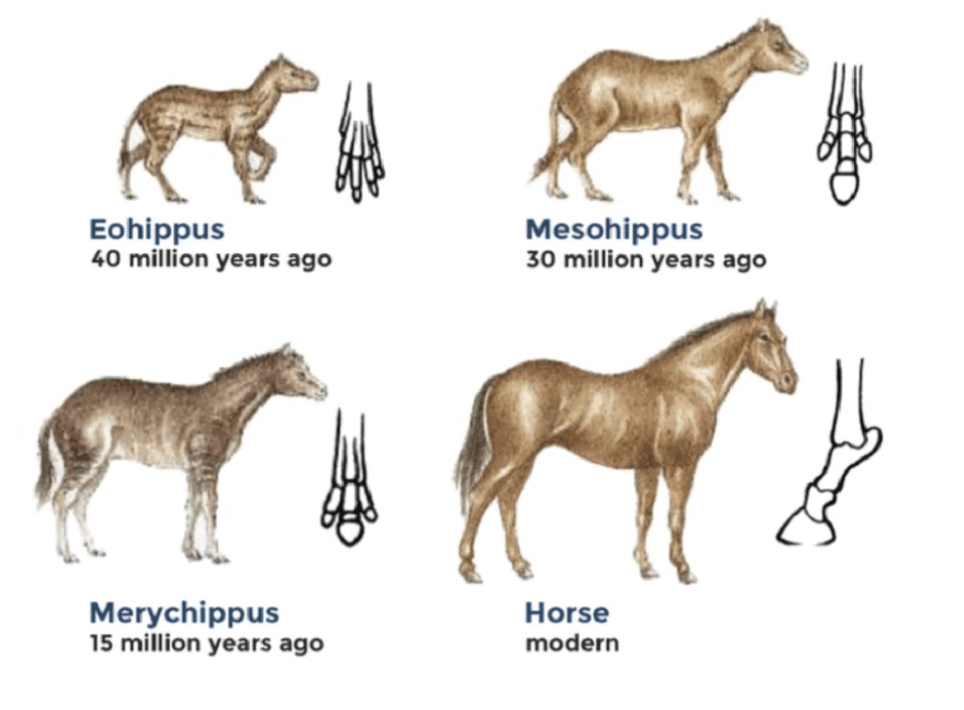
The diagrams below show the development of the horse over a period of 40 million years.
Practice this IELTS Writing Task 1 question on IELTSX. The diagrams below show the development of the horse over a period of 40 million years.
Horse Development Evolution 40 Million Years Diagram - IELTS Writing Task 1
You should spend about 20 minutes on this task.
Summarise the information by selecting and reporting the main features, and make comparisons where relevant.
Write at least 150 words.
A student's answer to this task, and the feedback on it
Written by an IELTSX user under exam conditions and published unedited and anonymously. Band 6.5 · 195 words.
The diagrams illustrate how the horse developed over a period of 40 million years, showing the changes in both its body structure and foot shape. Overall, it is clear that the horse become larger and taller throughout the period. In addition, its foot evolved from several toes to a single hoof, which is the key characteristic of the modern horse.
Forty million years ago, the earliest horse, known as Eohippus, was relatively small in size. Its foot consisted of four distinct toes. By 30 millions years ago, the species had evolved into Mesohippus, which was noticeably larger. At this stage, the number of toes had decreased to three, with the middle toe becoming prominent than the others.
Fifteen years ago, the horse had developed further into Merychippus. Its body was considerable bigger and more similar to that of a modern horse. Although it still possessed three toes, the central toe had become dominant, while the length of dominant toe had become smaller.
In the present day, the modern horse is the largest of all four stages shown. Its foot structure has changed significantly, with the side toes disappearing completely and only a single hoof remaining.
Examiner feedback
The response effectively summarizes the main trends and stages of the horse's evolution with a clear logical structure. To reach a higher band, focus on eliminating basic grammatical errors in comparatives and word formation, and ensure that data points like 'million' are included accurately to maintain factual precision.
Task Achievement - 7
- The response covers all requirements of the task, providing a clear overview of the main trends (size increase and foot evolution). - Key features are highlighted, but there is a factual inaccuracy where the student writes 'Fifteen years ago' instead of 'Fifteen million years ago'. - All stages shown in the diagram are mentioned and described with relevant data.
Coherence & Cohesion - 7
- Information and ideas are logically organized following a chronological sequence of the horse's evolution. - Paragraphing is used appropriately to separate different stages of development. - Cohesive devices like 'In addition', 'At this stage', and 'Although' are used effectively to link ideas, though some referencing could be more sophisticated.
Lexical Resource - 6
- The vocabulary is generally adequate for the task, including specific terms from the diagram like 'Eohippus' and 'hoof'. - There are errors in word formation, such as using the adjective 'considerable' instead of the adverb 'considerably' to modify 'bigger'. - The range of vocabulary for describing change is functional but somewhat repetitive.
Grammatical Range & Accuracy - 6
- A mix of simple and complex sentence forms is used, but there are several errors in basic grammar. - Mistakes include subject-verb agreement ('horse become' instead of 'became') and incorrect comparative structures ('prominent than' instead of 'more prominent than'). - There is an error in pluralization with '30 millions years ago' (should be 'million').
Related prompts
- Male Female Students Art Related Subjects UK University 2011
- Town Centre Changes 1990 and Today
- Male Female Students High Grades Five Subjects Parston School National Average
- Qualifications Staff Advertising Company 1990 and 2010
- Australian School Leavers Activity 1980 1990 2000
- Layout Town Shopping Centre Present and Future Redevelopment